
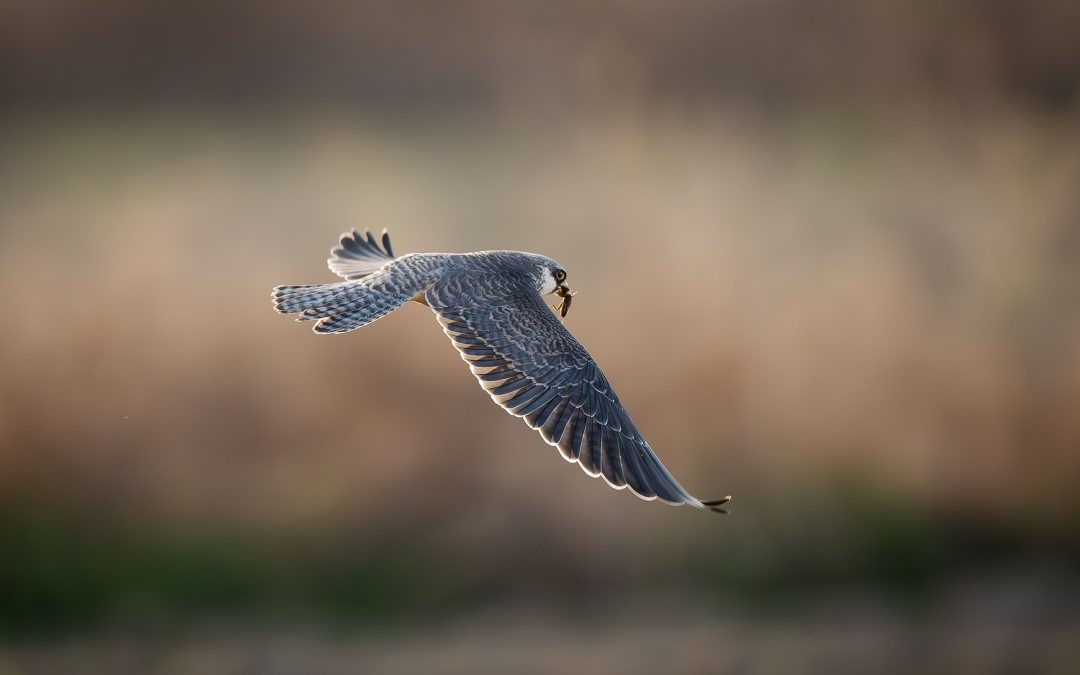
As the LIFE for Falcons project draws to a close, five years of conservation work in Bulgaria and Romania leave behind more than practical results. They have brought new knowledge about one of Europe’s most remarkable birds of prey, strengthened cooperation between conservationists and helped bring the Saker Falcon closer to the attention of the public.
There is something special about watching a falcon in flight. Its speed, precision and effortless command of the open sky make it one of the most fascinating birds of prey to encounter in the wild. Yet, for some species, the future is far less certain than their flight might suggest.
The Saker Falcon (Falco cherrug) is one of them. Once more widespread across the open landscapes of south-eastern Europe, this impressive raptor has faced significant population declines and continues to require dedicated conservation efforts.
After five years of work, the European LIFE for Falcons project is now approaching its conclusion. Bringing together specialists from seven organisations in Bulgaria and Romania, the initiative has focused on improving the prospects of the Saker Falcon and supporting the recovery of its populations in the region.
As the project comes to an end, it is a good moment to look back at what has been achieved, what we have learned and why this work remains important.
A conservation effort that goes beyond protecting a single species
The LIFE for Falcons project, officially titled Ensuring the Restoration of the Saker Falcon Population, an Endangered Species in Bulgaria and Southern Romania, was built around a simple but important understanding: protecting a bird of prey means protecting the landscape and ecological relationships that allow it to survive.
Coordinated by the Bulgarian Society for the Protection of Birds (BSPB), the project brought together the Romanian Ornithological Society (SOR), Green Balkans, the Institute of Biodiversity and Ecosystem Research at the Bulgarian Academy of Sciences, the Union of Hunters and Anglers in Bulgaria, the Habitat Foundation and the University of Tübingen in Germany.
The work covered 23 protected areas in Bulgaria and five in south-eastern Romania, all part of the European Natura 2000 network.
Rather than concentrating on the falcons alone, the conservation strategy addressed several interconnected challenges: the availability of suitable nesting sites, the presence of sufficient prey, human-related threats and the need for greater public awareness.
This broader approach is particularly important for a species that depends on healthy open habitats and suitable conditions across a large geographical area.
Restoring the conditions that allow falcons to thrive
One of the important aspects of the project has been improving the conditions needed for the Saker Falcon to establish and maintain breeding territories.
Safe nesting platforms and better breeding habitats are essential, particularly in landscapes where suitable natural nesting locations may be limited. The project also addressed threats associated with human infrastructure and persecution, including the risk of electrocution.
Food availability is another crucial element. Saker Falcons depend on small mammals and birds, and the condition of their prey populations directly influences their ability to reproduce successfully.
For this reason, the project included measures aimed at supporting populations of important prey species, such as European ground squirrels, hamsters and wild pigeons.
During 2026, the conservation teams continued working on ways to improve the availability of prey, including identifying opportunities to restore rodent populations. They also explored practical solutions to reduce conflicts between birds of prey and pigeon breeders.
These activities illustrate an important principle in wildlife conservation: long-term success often depends on finding ways for people and wildlife to coexist.
Learning more about the Saker Falcon
Conservation is not only about direct interventions in the field. It also requires a better understanding of the species being protected.
Throughout the project, monitoring activities generated valuable information about the Saker Falcon’s population, breeding behaviour and habitat requirements. Some of these findings have been developed into scientific studies, contributing to a better understanding of the species across Europe.
Three scientific publications stand out among the research results.
One study examined the parental behaviour of Saker Falcons in Bulgaria, documenting an exceptional breeding event in 2025, when a pair successfully raised five chicks. This is a remarkable result for a species whose population is still recovering in the country.
Another publication looked beyond national borders, analysing changes in the European Saker Falcon population between 2012 and 2022. The research highlighted significant differences between regions and reinforced the importance of coordinated conservation measures that follow ecological realities rather than administrative boundaries.
A third study focused on the Saker Falcon population in southern Romania. Based on monitoring carried out between 2016 and 2023, researchers examined population trends, nesting preferences and the potential impact of wind energy infrastructure on the species.
Together, these studies provide valuable information for future conservation planning. They also demonstrate why long-term monitoring and cooperation between researchers are essential when working to recover threatened wildlife populations.
A future that depends on people, too
Even the most carefully planned conservation measures can only achieve so much without the support and understanding of the people who share their landscapes with wildlife.
One of the objectives of LIFE for Falcons has therefore been to make the Saker Falcon better known and appreciated by the public.
Birds of prey sometimes find themselves at the centre of misunderstandings or conflicts with human activities. Pigeon breeders, for example, may perceive falcons as a threat to their birds. Addressing these situations requires more than scientific knowledge; it also involves communication, dialogue and practical solutions that take different interests into account.
By bringing together conservation specialists, local stakeholders and the wider public, the project has helped create a better foundation for protecting the species in the future.
After all, people are more likely to care about something they know and understand. And the more familiar a species becomes, the greater the opportunity to build support for its protection.
The work continues beyond the project
The conclusion of LIFE for Falcons marks the end of an important chapter, but it does not mean that the work of protecting the Saker Falcon is finished.
The ultimate ambition remains to restore its populations to a favourable conservation status, so that one day the species will no longer be considered Critically Endangered.
This will require continued monitoring, habitat protection, cooperation between countries and the involvement of people living in the landscapes where these falcons hunt and breed.
For those of us who enjoy exploring nature, projects like LIFE for Falcons are also a reminder of what lies behind the landscapes we travel through. Open grasslands, agricultural areas and seemingly ordinary stretches of countryside can support remarkable wildlife, often without us even noticing it.
The recovery of a species is rarely the result of one spectacular intervention. More often, it is built through years of patient work, careful research, practical conservation measures and the dedication of people who believe that a different future is possible.
Every chick that successfully leaves its nest, every breeding pair that establishes a territory and every person who learns to recognise and appreciate the Saker Falcon represents another reason for optimism.
And perhaps that is one of the most valuable legacies of LIFE for Falcons: not simply what has been achieved over the past five years, but the knowledge, cooperation and awareness that will continue to support this remarkable bird long after the project itself has ended.
This article draws on information published by the Romanian Ornithological Society (SOR) and the LIFE for Falcons project. Learn more about the initiative and its conservation objectives at saveraptors.org.